Monday, March 24, 2008

Honu: Hawaiian Green Sea Turtle


Honu: Hawaiian Green Sea Turtle

Hi all,
Just a quick hello... Dave's brother Rob and sister-in-law Tonya have been visiting us this week from Tennessee (now that's a long flight!) Yesterday was one of the most amazing snorkel experiences we've had yet on the islands in terms of swimming with turtles.
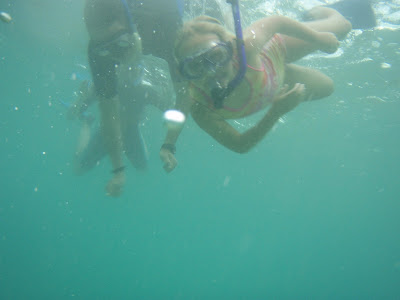
Ellie and Uncle Rob


We drove all the way to Ha'ena (the end of the road on the North Shore). The ocean was uncharacteristically calm for this time of year and we were able to snorkel on the outside perimeter of the reef. Turtles, turtles, turtles by the dozens! I asked Kate how many turtles she thought she swam with. She held up 10 fingers twice. It think she was probably right... There were so many turtles, at points it seemed they were swimming fin to fin. It's great to see such a healthy population as Hawaiian Green Sea turtles are currently still listed as threatened.
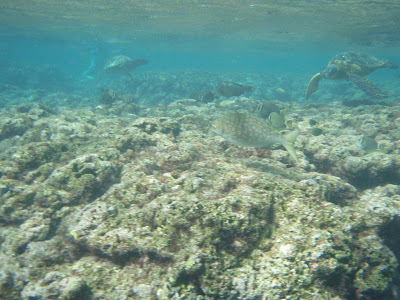


Tasty algae covers the reef

If you're interested in learning more about Hawaiian Green Sea Turtles, check out this link:
http://www.turtles.org/hawgrnd.htm


Susanne and Kate


Just flying along

Lots of love to all of you and we'll be in touch soon! S, D, E and K

Tuesday, March 11, 2008

Big Island Volcano

Inside the Thurston lava tube (about 500 years old)


Hi there,

In December we travelled to the Big Island to check out a live volcano up close. We learned LOTS of interesting things... The Big Island is actually made up of 5 volcanoes, 4 of which are not currently active. The tallest, Mauna Kea is nearly 14,000 feet above sea level, but the base of the mountain lies more than 18,000 feet below sea level making it almost 32,000 tall!... That's significantly taller (by nearly 2800 feet) than Mt. Everest! (In November when I was on the Big Island for the birth of my nephews, I drove up to the snow line. Boy was that strange to touch snow the same day I laid on the beach in 80 degree weather! Did you know people ski and snow board up there?!)

Above the Kilauea Caldera


Kilauea holds the title of being the world's most active volcano. It has been erupting continuously for the past 25 years! During our visit in December the live flow had moved further down the mountain. We spent a few days at the top exploring the old flow and learning about volcanoes before we ventured toward the live hot stuff! Even though it was a cold rainy day, we found many steam vents around which we warmed ourselves.

Hiking along the Ka'u Desert trail


Steam vents


In December the only way to reach the active flow was by helicopter. For me, the most memorable part of that flight was my door opening as we leaned into a turn right over the vent. Logic told me I was strapped in, but survival instinct left me white knuckled clutching the dash. I could really feel the heat and had less than no interest in becoming a human marshmellow!
Hot lava!
Thoughtfully, the pilot flew us out to an old flow... landed the copter... and securely fastened my door before completing our flight. The bonus was an unscheduled tour over a 1980's subdivision cut off by the earlier flow. All that remained were about 15 homes surrounded by a desert of black hardened lava. That's a real bummer of an investment!


The end of the road...


Shaka from our pilot

(Check out the video below)


Monday, March 10, 2008

Sunset surfers


Aloha friends and family!

Sorry we have been so lax in our "blogging". We've been seeing and doing and visiting and learning and travelling so much, it's been hard to find time to sit down at the computer and write. Yesterday we returned from an overnight camp out with the kids at Anini Beach (beginning of the North Shore). The kids begged Dave to put his surf board in the water and they "practiced" surfing literally until the sun went down. The next morning they were up with the sun (6:45am), and back in the water until we had to drag the kids home Sunday evening.

While the kids played, Dave snorkeled and tested out his new underwater camera. Anini Beach is surrounded by one of the largest reef systems on Kauai. In addition to the variety reef fish, Dave was thrilled to spot many types of thriving coral and several curious eels (all in only 4 - 6 feet of water!) Too bad we couldn't peel the kids away from the surfboard to take a look!


Lots of love to all. We're looking forward to seeing many of you soon!

D,S,K, & E


Thursday, November 15, 2007

ilio holo i kauaua: dog that runs in the rough seas


Over the past few weeks we have been really really lucky to observe the first few weeks in the life of a new baby Hawaiian Monk Seal. We've been visiting her at Mahaulepu Beach (one of my favorite places on this planet, about a mile from our house) where volunteers are posted dawn to dusk to protect the mamma and her baby. (Pictured here is baby at 2 days old. Note how large momma is and the furry black folds of skin on baby. The extra skin will give baby room to grow over the next few weeks.)


Dr. Mimi Olry, Marine Mammal Coordinator for the Island of Kauai says, "the importance of this birth to the monk seal population can hardly be overstated. It is the most endangered marine mammal in the United States". Hawaiian monk seals are the oldest living mammals on the planet. They stopped evolving some time around 14 million years ago and are essentially a living fossil. There are 3 known populations of monk seal: the Caribbean (now extinct) the Mediterranean (numbers down to less than 30), and the Hawaiian (numbers thought to be around 1200 remaining). This year on Kauai if the pupping goes well, there will be 5 monk seal births and 5 recorded monk seal deaths (not exactly a recipe for survival of a species). Sadly, reproduction and survival of pups overall is not keeping up with mortality.


Baby monk seals are born with jet black hair which will fall out over the nursing period as adult greyish brown hair grows in. Mommas "bulk up" before giving birth because they will not eat during the entire 5 - 7 week nursing period. Unlike the large colonies of sea lions we're used to seeing along the west coast, monk seals never evolved into social critters. Generally, they live a solitary life (perhaps the origin of their name "monk seals"). When the momma runs out of milk, she will wean and leave her pup permanently and it will have to find it's own way. (Can you imagine saying goodbye to your baby forever at 6 weeks old? To my knowledge, there is no other mammal on the planet that leaves it's baby this young.) At that point, the pup will have to live off the fat it's stored up until it can learn to catch food for itself.


Below is a photo of an adolescent male who "hauled out" a few hundred yards down the beach from momma and baby to rest and digest a night's worth of foraged food. Notice the green coloration... This is algae and will fall away as the seal begins it's annual molt.


Below are photos taken last weekend of the momma and her pup (4 1/2 weeks old). We now know the new pup is a girl... good news for the monk seal population! Look how thin momma has gotten! Momma has dropped at least 100 pounds and baby has probably gained close to that. When the baby was born she had furry folds of extra skin. Now she has become a round butterball on momma's milk (which is up to 50% fat!). While we were at Mahaulepu this past weekend momma took baby for a shallow swim around the beach. Even that short swim made baby hungry and she wouldn't stop pestering momma for more milk!


Local marine biologists think momma will probably wean the baby this week and return to her own sea adventures.


Ho' opomaika'i!

Good luck little one!


Ilio holo kai: Hawaiian Monk seal.

Thursday, November 1, 2007

Save our Shearwaters by Ellie Hancock

Hi. My name is Ellie and I want to tell you about Shearwaters because I don't want them to become extinct.
Here are some things to know about Shearwaters:
1. they build their nests in burrows and lay one egg.
2. they eat squid and tuna.
3. they sound like a crying baby.
4. they howl at the moon.
5. they fly at night and have to go 1000 miles to get their babys food.
6. they are getting extinct.
Here are some things that are not okay for shearwaters:
1. bright lights which can confuse the birds and make them run into something. (From mom: shearwaters use the moon to navigate at night. Bright lights cause them to become disoriented.)
2. no dogs or cats because they can eat shearwaters. (From mom: shearwaters nest on the ground which make them very vulnerable to non-native animals like cats and dogs.)
These are some things that can help shearwaters:
1. if you take a picture of a shearwater please take your flash off so the light won't bother the bird.
2. if you go near some shearwaters please put your dog or cat on a leash.
3. if you find a shearwater on the ground ask a grown up to help you. You can take it to an aid station or the fire station and they will put it in a safe place.
I want to help shearwaters so they won't be extinct.

Saturday, October 6, 2007

Molokai - Day 6: Riding at the ranch

Talk about packing it in... Ellie and I squeezed a quick trail ride in at the ranch before catching our 2pm flight back to Kauai...


Ellie enjoyed her ride and I enjoyed getting the local word on island politics first hand.

Molokai - Day 5: Wild Turkeys, Sea Kayaking and the cliffs of Kalaupapa

We were joined by a flock of wild turkeys for breakfast... guess they were hoping we could spare a few extra corn flakes...

After breakfast, we took the girls sea kayaking... Ellie paddled almost the entire 2 miles! (All that swimming has made her arms and shoulders strong!) I was really impressed!
Down the coast we entered a mangrove "forest" and paddled up a narrow stream (sometimes only the width of the kayak). We negotiated through the tunnel of branches and roots which often hung just above our heads. A few times Ellie and I almost ran face first into large spider webs stradling the creek. I don't know who was more freaked out by that... me or the 2" spider staring us down! The stream dumped us into an old "menehune fish pond" believed to be built as early as 800AD.
After the mangrove paddle, we all went out onto the reef and did some snorkeling. It was pretty windy and rough. Kate drank mouthfuls of sea water, but was a trouper! I couldn't talk her into getting back into the boat until Ellie came back in as well...
After kayaking we needed to rehydrate with an island favorite... old fashioned SHAVE ICE! Yum! Then headed up to the lookout over Kalaupapa (the old Leper Colony). Once we arrived on island we found that you have to be 16 to enter the colony, so we weren't able to take the donkey trail down. (Note: the trail goes down the 4000 ft. cliff on the left! These are the highest sea cliffs in the world, which is what made Kalaupapa the perfect prison to contain the lepers. What a sad story of inhumanity and ignorance.)