
Over the past few weeks we have been really really lucky to observe the first few weeks in the life of a new baby Hawaiian Monk Seal. We've been visiting her at Mahaulepu Beach (one of my favorite places on this planet, about a mile from our house) where volunteers are posted dawn to dusk to protect the mamma and her baby. (Pictured here is baby at 2 days old. Note how large momma is and the furry black folds of skin on baby. The extra skin will give baby room to grow over the next few weeks.)

 Dr. Mimi Olry, Marine Mammal Coordinator for the Island of Kauai says, "the importance of this birth to the monk seal population can hardly be overstated. It is the most endangered marine mammal in the United States". Hawaiian monk seals are the oldest living mammals on the planet. They stopped evolving some time around 14 million years ago and are essentially a living fossil. There are 3 known populations of monk seal: the Caribbean (now extinct) the Mediterranean (numbers down to less than 30), and the Hawaiian (numbers thought to be around 1200 remaining). This year on Kauai if the pupping goes well, there will be 5 monk seal births and 5 recorded monk seal deaths (not exactly a recipe for survival of a species). Sadly, reproduction and survival of pups overall is not keeping up with mortality.
Baby monk seals are born with jet black hair which will fall out over the nursing period as adult greyish brown hair grows in. Mommas "bulk up" before giving birth
 because they will not eat during the entire 5 - 7 week nursing period. Unlike the large colonies of sea lions we're used to seeing along the west coast, monk seals never evolved into social critters. Generally, they live a solitary life (perhaps the origin of their name "monk seals"). When the momma runs out of milk, she will wean and leave her pup permanently and it will have to find it's own way. (Can you imagine saying goodbye to your baby forever at 6 weeks old? To my knowledge, there is no other mammal on the planet that leaves it's baby this young.) At that point, the pup will have to live off the fat it's stored up until it can learn to catch food for itself.
Below is a photo of an adolescent male who "hauled out" a few hundred yards down the beach from momma and baby to rest and digest a night's worth of foraged food. Notice the green coloration... This is algae and will fall away as the seal begins it's annual molt.
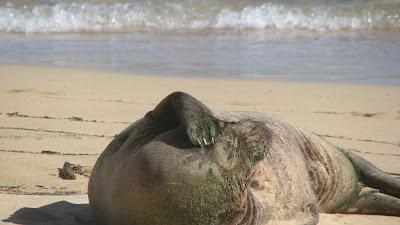

Below are photos taken last weekend of the momma and her pup (4 1/2 weeks old). We now know the new pup is a girl... good news for the monk seal population! 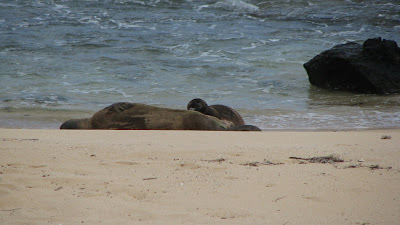 Look how thin momma has gotten! Momma has dropped at least 100 pounds and baby has probably gained close to that. When the baby was born she had furry folds of extra skin. Now she has become a round butterball on momma's milk (which is up to 50% fat!). While we were at Mahaulepu this past weekend momma took baby for a shallow swim around the beach. Even that short swim made baby hungry and she wouldn't stop pestering momma for more milk!
 Look how thin momma has gotten! Momma has dropped at least 100 pounds and baby has probably gained close to that. When the baby was born she had furry folds of extra skin. Now she has become a round butterball on momma's milk (which is up to 50% fat!). While we were at Mahaulepu this past weekend momma took baby for a shallow swim around the beach. Even that short swim made baby hungry and she wouldn't stop pestering momma for more milk!
Local marine biologists think momma will probably wean the baby this week and return to her own sea adventures.

Ho' opomaika'i!
Good luck little one!
Ilio holo kai: Hawaiian Monk seal.
Good luck little one!
Ilio holo kai: Hawaiian Monk seal.


